 Seville Food Tours
What to Eat in Seville
What to eat in Seville comes down to about sixteen dishes, three portion sizes and one price rule. This guide explains each plate in plain English, including the three locals order and visitors never do, plus what to drink with them and when the kitchens are actually open.
Quick answer Sixteen dishes, what each one actually is, and the three nobody orders
The dishes that define Seville are salmorejo, espinacas con garbanzos, jamon iberico, carrillada, pringa, montaditos, croquetas, bunuelos de bacalao, ensaladilla rusa, cola de toro, pescaito frito, tortilla, gazpacho, torrijas, churros con chocolate and, in the glass, manzanilla, vermut de grifo, tinto de verano and vino de naranja. Three of them, pringa, carrillada and boquerones en vinagre, are what separate a local order from a tourist one, and none of them appears on an English menu with an explanation. Portions come in three sizes and the same dish costs half as much standing at the counter as it does on a terrace.
Key takeaways
- Order by size: a tapa is a taste, a media racion feeds one, a racion feeds two to three
- Espinacas con garbanzos is the Moorish inheritance and usually the cheapest thing on the board
- Pringa is the city's own sandwich: shredded stew meats in a warm mollete roll
- Ask for tinto de verano, not sangria: that is what people actually drink in August
- A guide orders these for you in the right order on any Seville food tour
The Savoury Plates That Define the City
The four you will meet on every counter
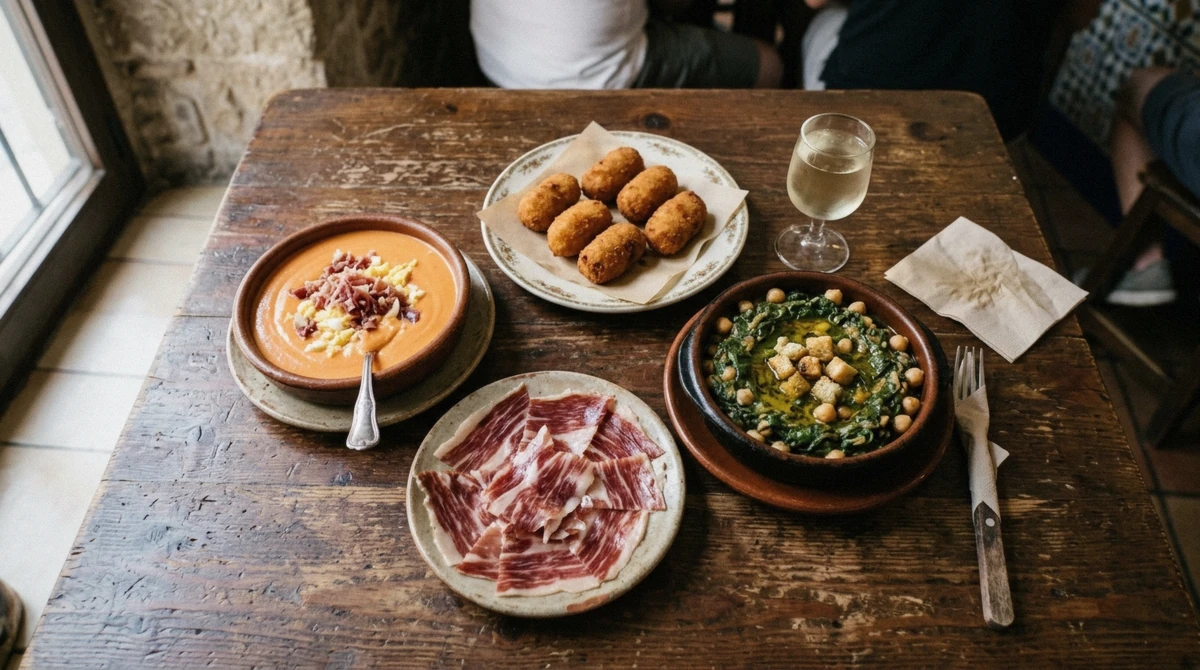
Salmorejo is the one to learn first: cold, thick, tomato and bread blended with olive oil and garlic into something closer to a cream than a soup, topped with chopped jamon and hard-boiled egg. It is from Cordoba, an hour north, but Seville adopted it completely. Gazpacho is its thinner cousin and is often drunk from a glass.
Espinacas con garbanzos, spinach with chickpeas, cumin, paprika and a little vinegar, carries the city's Moorish past more directly than any monument. It is usually among the cheapest tapas on the board, often around EUR 3.50, and it is the dish to order to judge a bar.
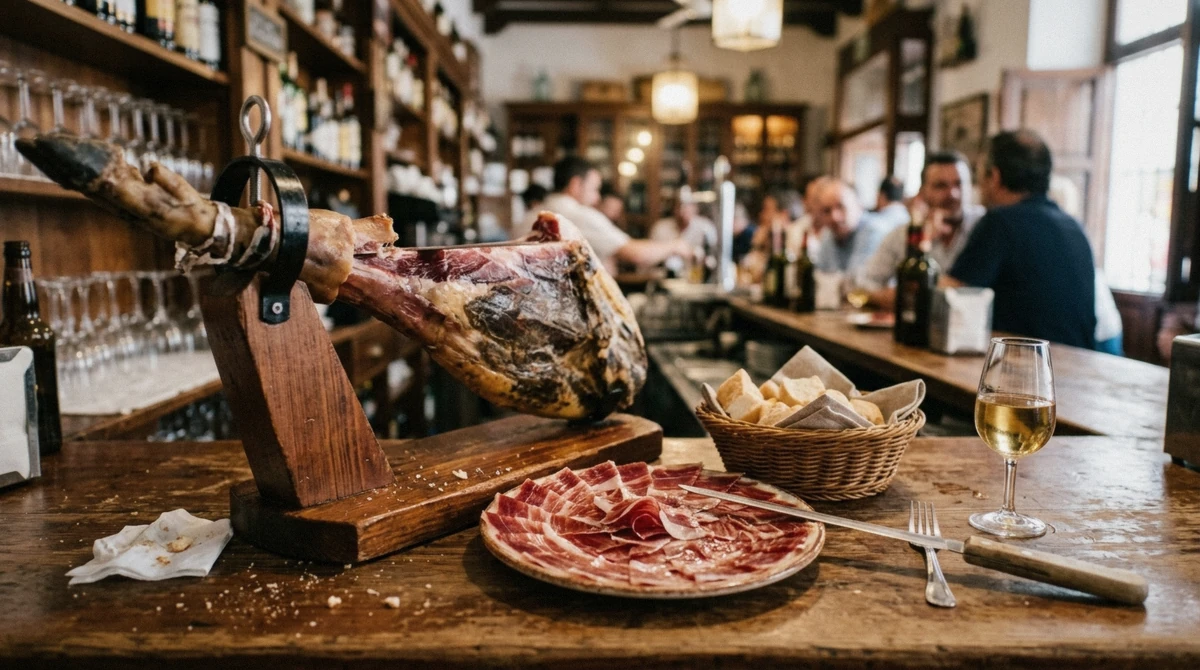
Jamon iberico is the cured ham from acorn-fed black-hoofed pigs, sliced to order and served at room temperature so the fat softens. Croquetas are bechamel fritters, ham, chicken or cod, crisp outside, molten inside, and the other reliable test of a kitchen.
The three that mark you as a local
Pringa is Seville's own sandwich, and almost no visitor orders it because no menu explains it. It is the meat left in the pot after a puchero, pork, beef, chorizo and morcilla stewed for hours, shredded into a paste and pressed into a warm mollete roll. It costs a few euros and is the best thing in half the bars in the city.
Carrillada iberica is pork cheek braised in dark gravy until it collapses under a fork; it usually comes as a racion, which is why it is easier to meet on a guided crawl than to order alone. Boquerones en vinagre, fresh anchovies cured in vinegar and garlic, are the plate that divides people who like Spanish food from people who like Spanish restaurants. Nobody who tries them properly cured goes back to the tinned version.
Fried, cold and stewed
Bunuelos de bacalao are salt-cod fritters and a Seville speciality; pescaito frito is the wider category of lightly floured fried fish: boquerones, chopitos, cazon en adobo, which Andalusia does better than anywhere in Spain and which is eaten by the paper cone at the Feria.
Ensaladilla rusa is the potato-and-tuna salad every bar makes slightly differently and every local has an opinion about. Cola de toro is oxtail stewed for hours, heavier and more common in autumn and winter, and a legitimate main course rather than a tapa. Tortilla de patatas needs no explanation except one: in Andalusia it is generally served jugosa, still soft in the middle.
Sweet, and What Is in the Glass
Breakfast, dessert and the convent trade
Churros con chocolate are breakfast or a mid-morning stop, not a dessert: sold from a kiosk or a churreria, dipped in chocolate thick enough to stand a spoon in. The morning market tour starts at a churros kiosk in Macarena for exactly this reason.
Torrijas appear around Semana Santa: bread soaked in milk and egg, fried and dusted with sugar and cinnamon. Pestinos, anise-and-sesame fritters in honey, belong to the same weeks. Much of Seville's traditional confectionery still comes from convents, sold through a revolving wooden hatch so the nun and the customer never see each other.
The glasses that are not wine as you know it
Manzanilla and fino are bone-dry sherries aged under a living layer of yeast called flor, served cold and drunk with food rather than after it. Amontillado and oloroso are darker and nuttier; Pedro Ximenez is the sweet one poured over ice cream. The sherry tasting walks all five in ninety minutes.
Vermut de grifo is house vermouth from the barrel, the drink of the hour before lunch. Tinto de verano, red wine, soda, ice, lemon, is what locals actually order in August while visitors order sangria. And vino de naranja, Seville orange wine, is the city's own sweet closer, macerated with the bitter oranges from the street trees.
How to Order Without Getting It Wrong
Three sizes, one price gradient
Andalusian bars sell most dishes in three sizes, and the menu will not explain them. Knowing them is the difference between four dishes shared happily and one enormous plate of pork cheeks nobody can finish.
| Size | What it is | Roughly |
|---|---|---|
| Tapa | A taster portion, one or two bites each | EUR 2-4 at the counter |
| Media racion | A half plate, a light meal for one | EUR 6-10 |
| Racion | A full plate to share between two or three | EUR 10-18 |
| Montadito | A small filled roll, usually pork | EUR 2.50-4 |
Where you stand changes the bill
The same tapa costs about EUR 2-4 standing at the counter in a traditional bar and about EUR 7 seated on a terrace facing the Cathedral. Many bars charge a small supplement for a table and a larger one for the terrace, and it is printed on the menu in small type.
The practical rule: eat standing where locals eat standing, and save the sitting down for the one long dinner you actually want. The full breakdown is in what a Seville tapeo costs.
When the kitchens are open
Lunch runs roughly 14:00 to 16:00 and is the main meal; dinner kitchens generally reopen between 20:00 and 21:00, and Sevillanos eat between 21:00 and 23:00. Between those windows bars serve drinks and whatever cold tapas are on the counter.
That timetable is why evening food tours start around 18:00 to 19:00, they use the quiet window before the city sits down, which means the tour is your dinner rather than a warm-up for one.
A Menu, Translated
The words you will actually see
Most Seville bars write their board in Spanish only, in chalk, in an abbreviated form. This is the vocabulary that decodes it. Prices are counter prices in a traditional bar, checked in August 2026.
| On the board | What arrives | Typical price |
|---|---|---|
| Espinacas con garbanzos | Spinach and chickpeas, cumin, paprika | EUR 3-4 |
| Montadito de pringa | Warm roll with shredded stewed meats | EUR 2.50-4 |
| Carrillada iberica | Braised pork cheek in dark gravy | EUR 9-14 as a racion |
| Bunuelos de bacalao | Salt cod fritters | EUR 4-7 |
| Boquerones en vinagre | Anchovies cured in vinegar and garlic | EUR 3-5 |
| Cazon en adobo | Marinated dogfish, floured and fried | EUR 4-6 |
| Ensaladilla rusa | Potato, tuna and mayonnaise salad | EUR 3-5 |
| Cola de toro | Oxtail stewed for hours | EUR 12-18 as a racion |
| Chocos fritos | Fried cuttlefish | EUR 5-8 |
Three phrases that change the order
Una tapa, por favor keeps the portion small. Say nothing and a busy barman may bring you a media racion, which is twice the food and twice the price. On a tapeo of four bars, that mistake at the first stop ends the evening at the second.
Sin jamon, sin huevo turns salmorejo vegetarian. Andalusian kitchens garnish reflexively, and the base of most vegetable dishes is fine without the finish. The vegetarian and vegan guide covers the rest of the phrasing.
Que me recomienda? is the one that gets you the good stuff. Bar staff in Seville are not being rhetorical when they gesture at a chalkboard: the two or three things a kitchen cooks well that day are rarely the same as the twenty printed on the laminated menu. If you take a food tour on the first evening, this is the question your guide is effectively answering for three hours.
What to Order First, By Traveller
If You want one dish that explains the city
Espinacas con garbanzos. Cheap, everywhere, and the clearest surviving trace of Seville's Moorish kitchen.
If You want the thing locals order that you would never find
Montadito de pringa. It is on the Secret Food Tour tasting list and in half the bars in the centre.
If You are eating with someone who does not like fish or pork
Berenjenas con miel de cana, grilled artichokes, patatas bravas and tortilla will carry the whole evening.
If It is 36 degrees and you are not hungry
Salmorejo and a cold manzanilla. Both are designed for exactly this weather.
If You want to learn to cook it rather than order it
The Triana cooking class puts salmorejo, an Andalusian tapa, paella and a dessert on the bench in front of you.
Where Each Dish Belongs
The city eats to a timetable
A dish ordered at the wrong hour arrives badly or not at all. Churros are breakfast or a mid-morning stop, not a dessert, and most churrerias close by noon. Salmorejo and gazpacho are summer dishes, and a bar will serve them in January without enthusiasm. Cola de toro and puchero are winter food that takes hours and appears when a kitchen has time.
The daily rhythm matters as much as the season, and it is stricter here than visitors expect. The table below is the one the city actually keeps.
That mid-afternoon gap is exactly the window the evening food tours use, which is why a guided crawl starting before the restaurant kitchens open can move a group of ten through four bars without a queue at any of them.
| Hours | What is being served | What to order |
|---|---|---|
| 08:00-11:00 | Breakfast: toast, coffee, churros | Tostada with tomato and olive oil; churros con chocolate |
| 14:00-16:00 | Lunch, the main meal of the day | Menu del dia, or raciones to share |
| 16:00-20:00 | Kitchens closed, bars pouring | Vermouth, olives, cold counter tapas |
| 20:00-21:00 | Dinner kitchens reopen | Anything braised: carrillada, cola de toro |
| 21:00-23:00 | The city sits down | A full tapeo, or a proper sit-down dinner |
What to order for each occasion
For a first meal: espinacas con garbanzos, croquetas and a montadito, standing at a counter. Cheap, quick and representative.
For a long lunch: the menu del dia at EUR 12-15, or raciones shared with cold beer. For a hot afternoon: salmorejo, boquerones en vinagre and a cold manzanilla. For a proper evening: carrillada or cola de toro as a racion between two, with red wine rather than sherry.
And for the last night, when you know what you like: go back to the bar you found on the second day and order the same three plates again. That is what everyone who lives here does, and it is the real reason to take a food tour early enough for the list to be useful.
Questions About Eating in Seville
What is the most famous food in Seville?
Salmorejo, espinacas con garbanzos and jamon iberico are the three most identified with the city, with pescaito frito close behind. If you order one dish to understand Seville, make it spinach with chickpeas, it is cheap, everywhere, and the clearest surviving trace of the city's Moorish kitchen.
What do people eat for breakfast in Seville?
Toast with tomato and olive oil, or with lard-based zurrapa, plus coffee; churros with thick chocolate at a kiosk on a slower morning. Breakfast is small because lunch at 14:00 is the serious meal.
Are tapas free in Seville?
No, that is Granada. In Seville every tapa is a paid item, from about EUR 2 at a traditional counter to around EUR 7 on a monument terrace.
What is pringa?
The shredded meats left from a puchero stew, pork, beef, chorizo and morcilla, pressed into a warm mollete roll. It is Seville's own sandwich and one of the cheapest good things in the city. The Secret Food Tour puts it on the tasting list.
What should vegetarians order?
Espinacas con garbanzos, salmorejo (ask for it without ham and egg), fried aubergine with cane honey, grilled mushrooms, artichokes and patatas bravas. See the vegetarian and vegan guide for the bars that do it well.
What should I drink with tapas?
A cana of cold beer, a glass of manzanilla or fino sherry, vermouth from the barrel before a meal, or tinto de verano in the heat. Sangria is a tourist drink here; nobody at the counter is ordering it.