 Seville Food Tours
Vegetarian and Vegan Guide to Seville
Vegetarian tapas in Seville are easier to find than the city's reputation suggests, and vegan eating is harder than in most cities its size. This guide lists the traditional dishes that are already meat-free, the three traps that catch people out, the districts where the vegan kitchens are, and: copied from the operators' own listings, which food tours will accept your booking at all.
Quick answer Which dishes are safe, which tours refuse you, and the one that adapts
Seville is easier for vegetarians than its reputation suggests and harder for vegans than most cities its size. The traditional kitchen gives you espinacas con garbanzos, fried aubergine with cane honey, grilled artichokes, mushrooms, patatas bravas and salmorejo, though salmorejo arrives topped with ham and egg unless you ask. Vegans do best around the Alameda de Hercules and Calle Feria, where the modern and dedicated kitchens are. On guided tours the picture is blunt: most listings state outright that they cannot accommodate vegans or vegetarians, and only the Triana cooking class says it can adapt for vegetarian, vegan and gluten-free diets with notice.
Key takeaways
- Order espinacas con garbanzos first, it is vegan as cooked in most bars and on nearly every menu
- Ask for salmorejo sin jamon y sin huevo; the base itself is tomato, bread, oil and garlic
- Watch for hidden pork: many vegetable dishes are finished with ham, and stock is rarely vegetarian
- Alameda de Hercules and Calle Feria are where the dedicated vegan kitchens are
- Only one tour in the Seville food tours we compare adapts: the Triana cooking class
What the Traditional Kitchen Gives You
The dishes that are already vegetarian
Andalusian bar food is built on pork, but the vegetable half of it is genuinely old and genuinely good: much of it inherited from the Moorish and Jewish kitchens the city has been layering for a thousand years.
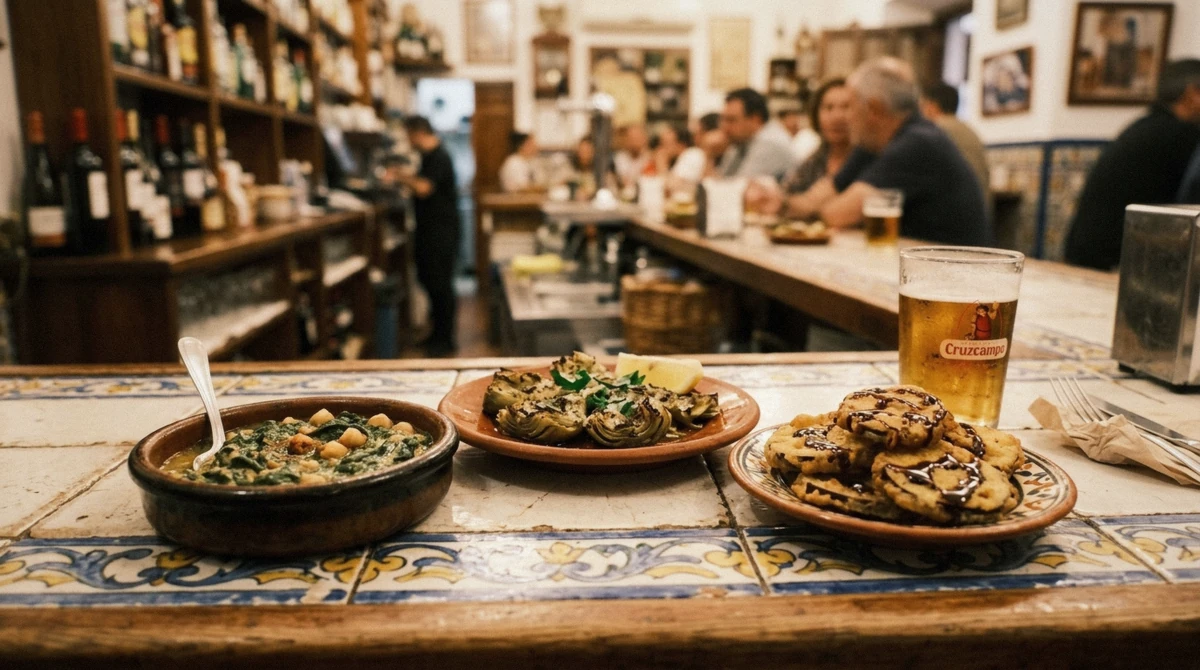
Espinacas con garbanzos, spinach with chickpeas, cumin and paprika, is the one to learn. It is on nearly every board, usually among the cheapest tapas on the board at around EUR 3.50, against EUR 5-8 for a plate of jamon, and as cooked in most bars it contains no animal product at all. Berenjenas con miel de cana, aubergine fried in thin batter and drizzled with cane syrup, is the other everyday winner. Add grilled artichokes, mushrooms with garlic, patatas bravas, pimientos de padron, and the cold soups: salmorejo and gazpacho, and a vegetarian eats well without any special effort.
The traps
Three things catch people out.
Salmorejo comes topped with ham and egg by default; the base is vegan but the garnish is not, so ask for it sin jamon y sin huevo. Vegetable dishes are often finished with pork: chickpeas cooked with chorizo, beans with ham, spinach sometimes with a little jamon stirred through in the more traditional kitchens. And stock is rarely vegetarian: soups and stews start from a puchero base.
The useful phrase is soy vegetariano/a, sin carne y sin pescado: and, if you are vegan, sin queso, sin huevo, sin miel on top. Tortilla de patatas is not vegan. Neither is most bread served with lard-based spreads at breakfast.
Where the vegan kitchens are
North of the centre is the answer. The Alameda de Hercules and Calle Feria hold the modern kitchens, and the dedicated vegan places cluster there: Vegan Rock on the Alameda serves veganised versions of traditional tapas, Vegani sits on Calle Feria, and Veganitessen operates out of the Arenal market closer to the river.
On the traditional side, a number of old bodegas will put together a full vegan meal without fuss: spinach and chickpeas, fried aubergine, grilled mushrooms, artichoke hearts, salmorejo without the garnish. The trick is to eat where the kitchen actually cooks rather than reheats, which is the same rule that applies to everyone else.
Distances are short: the Alameda is a 15-minute walk north of the Cathedral, and Calle Feria runs another 10 minutes beyond it. Expect EUR 10-14 for a vegan menu del dia there against EUR 12-15 for the conventional version in the centre.
Food Tours: Who Will Feed You
What each operator states, in its own words
This is the part that decides the booking, and it is buried at the bottom of every listing. Copied from the operators' own text in August 2026.
| Tour | Vegetarian | Vegan | Gluten-free |
|---|---|---|---|
| Triana cooking class | Yes, with notice | Yes, with notice | Yes, with notice |
| Tapas + flamenco | Yes | No | Not for coeliacs |
| Triana tapas tour | At extra cost | At extra cost | Ask |
| Secret Food Tour | Ask ahead | Ask ahead | Ask ahead |
| Food tour with a local | Handled on request | Ask ahead | Ask ahead |
| Tapas, Taverns & History | Case by case | No | No |
| Tapas Crawl | No | No | No |
| Triana market tasting | No | No | Ask |
| Morning market tour | No | No | No |
Why so many say no
It is not indifference, it is the pre-ordered menu. Three operators state plainly that the food is ordered before you arrive so the group can move through four bars in three hours. A menu ordered in advance cannot be rewritten at the counter, which is why an allergy declared on the night cannot be worked around and why vegans are turned away at booking rather than disappointed at the table.
That also explains why the class is the exception. A kitchen with a chef and a shopping list can cook something else; a bar crawl with plates already on the pass cannot.
The honest recommendation
If you are vegetarian, several tours will feed you, one reviewer travelling with a vegetarian husband reported more than enough for him on the Spain Food Sherpas walk, but tell the operator when you book, not on the night.
If you are vegan, book the Triana cooking class and eat the rest of your meals around the Alameda. It is the only listing that commits in writing, it is hands-on, and the market walk in the morning session is worth the early start. If you are coeliac, the same class is the only one that mentions gluten-free at all; every other listing warns about cross-contamination.
Ordering, Phrase by Phrase
What to say, and what it gets you
Bar staff in Seville are generally helpful about this and generally not fluent in dietary categories, so specifics work better than labels. These phrases are worth having on your phone.
| Say this | It means | Why it matters |
|---|---|---|
| Soy vegetariano / vegetariana | I am vegetarian | Often understood as: no red meat. Follow with the specifics |
| Sin carne y sin pescado | No meat and no fish | Ham and tuna are frequently not counted as either |
| Sin jamon, sin huevo | No ham, no egg | Turns salmorejo and several salads vegan |
| Lleva caldo de carne? | Does it have meat stock? | Stews and soups usually start from a puchero base |
| Sin queso y sin miel | No cheese, no honey | Aubergine comes with cane syrup, which is fine; some kitchens use honey |
| Que verduras tiene hoy? | What vegetables do you have today? | Gets you the kitchen's actual produce rather than the printed menu |
Two practical rules
Declare it when you book, not when you arrive. Every operator in this catalogue orders the menu in advance, which is exactly why most of them cannot improvise. The same is true of small restaurants at 21:30 on a Saturday. A message sent through the booking platform two days out gets a better dinner than a conversation at the table.
Eat where the kitchen cooks. Bars that reheat have a fixed list; bars that cook have vegetables. The tell is a short chalkboard that changes rather than a long laminated menu, which is the same rule set out in the tapas bar guide for everyone else.
How to Plan the Trip
If You are vegetarian and travelling with meat eaters
Stay in the traditional bars. Espinacas con garbanzos, aubergine with cane syrup, artichokes and tortilla cover you at almost every counter.
If You are vegan
Base yourself around the Alameda de Hercules and Calle Feria, and book the Triana cooking class if you want a guided experience.
If You are coeliac
Skip the crawls, which all warn about cross-contamination, and take the cooking class, which states gluten-free menus are available with notice.
If You want a guided evening anyway
Read the diet column before you pay. Every listing's stated position is on the Seville food tours comparison.
Breakfast, Lunch and the Rest of the Day
The meals nobody plans for
Dinner gets all the attention, but the awkward meals for vegetarians in Seville are the other two.
Breakfast is usually toast with olive oil and grated tomato, which is vegan and on every counter, at EUR 2.50-4 with coffee. Avoid the lard-based spreads, manteca colora and zurrapa, which are the traditional alternative and are pork.
Lunch is where the menu del dia becomes a problem. Three courses for EUR 12-15 is the best value in the city, and the set options are often built on meat or fish. The workaround is to ask which of the first courses are vegetarian, since the starter list is where the vegetables live: gazpacho, salmorejo, salads, spinach with chickpeas. A number of bars will let you take two starters as your two courses if you ask.
Snacks are the easy part. Olives, almonds, crisps and pan con tomate are everywhere, and the cold soups are drinkable from a glass in summer.
Two dishes worth crossing the city for
Berenjenas con miel de cana is the dish that converts sceptics: aubergine cut thin, fried in a light batter, drizzled with dark cane syrup from the sugarcane fields of the Granada coast. It is on most boards at EUR 4-6 and it is vegetarian everywhere and vegan in most places.
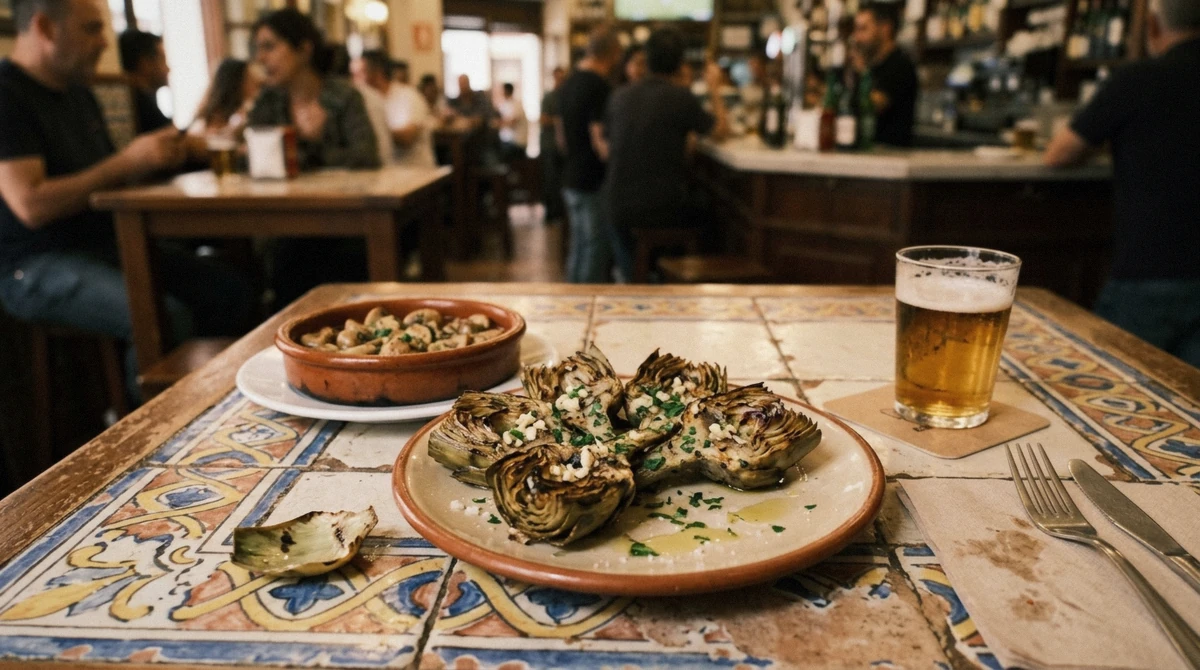
Alcachofas a la plancha, artichokes grilled with garlic and olive oil, appear from late winter into spring and are at their best in March and April. Both are traditional Andalusian bar food rather than concessions to visitors, which is the point: eating well here as a vegetarian is mostly about ordering the old dishes rather than looking for new restaurants. The exception is the guided experience, where only the Triana cooking class commits in writing, as the diet column on the Seville food tours page shows.
Questions About Vegetarian and Vegan Eating in Seville
Is Seville good for vegetarians?
Better than expected. Espinacas con garbanzos, fried aubergine with cane honey, grilled artichokes, mushrooms, patatas bravas and the cold soups are on nearly every menu. Vegans have a narrower traditional menu and should head for the Alameda de Hercules and Calle Feria.
What vegetarian tapas should I order?
Espinacas con garbanzos, berenjenas con miel de cana, alcachofas a la plancha, champinones al ajillo, pimientos de padron, patatas bravas, and salmorejo asked for without ham and egg.
Is salmorejo vegetarian?
The base is: tomato, bread, olive oil, garlic, but it is served topped with chopped jamon and hard-boiled egg. Ask for it sin jamon y sin huevo and you have a vegan dish.
Which Seville food tour is best for vegans?
The Triana cooking class is the only listing that states it can be made vegetarian, vegan or gluten-free with advance notice. Most tapas crawls say outright that they cannot accommodate vegans.
Are there hidden meat ingredients to watch for?
Yes. Chickpeas cooked with chorizo, beans with ham, spinach finished with jamon in traditional kitchens, and stock made from a puchero base. Ask before assuming a vegetable dish is meat-free.
Where are the vegan restaurants in Seville?
Mostly north of the centre around the Alameda de Hercules and Calle Feria, with one inside the Arenal market. That is also the district with the modern tapas kitchens, so a mixed group can eat in the same place.