 Seville Food Tours
Best Tapas in Seville
The best tapas in Seville are spread across four districts that eat differently: the old institutions of Centro and Alfalfa, one honourable exception in Santa Cruz, the fish-and-sherry bodegas of Triana, and the modern kitchens around the Alameda. This guide names the bars worth the walk, what to order in each, and the five signals that tell you to keep walking.
Quick answer Four neighbourhoods, the institutions in each, and what to order at the counter
The best tapas in Seville are not in one street, they are in four districts that each eat differently. Centro and Alfalfa hold the old institutions, including El Rinconcillo, trading since 1670 and the oldest bar in the city, and Bodeguita Romero, run by the same family since 1939 and known for the best montadito de pringa in Seville. Santa Cruz is beautiful and mostly overpriced, with Las Teresas (1870) the honourable exception. Triana across the river eats more fish and drinks more sherry. Alameda and Feria are where the modern kitchens are, and where vegetarians eat best.
Key takeaways
- Eat standing at the counter: the same plate costs EUR 2-4 there and about EUR 7 on a Cathedral terrace
- El Rinconcillo (1670) is the oldest bar in the city: order espinacas con garbanzos there
- Bodeguita Romero for montadito de pringa; Casa Morales (1850) for stew on a Tuesday or Thursday
- Cross the river to Triana for fried fish, sherry and Calle Betis at dusk
- A guided tapas crawl does four of these bars in one evening with the ordering done for you
Centro and Alfalfa: The Old Institutions
El Rinconcillo, since 1670
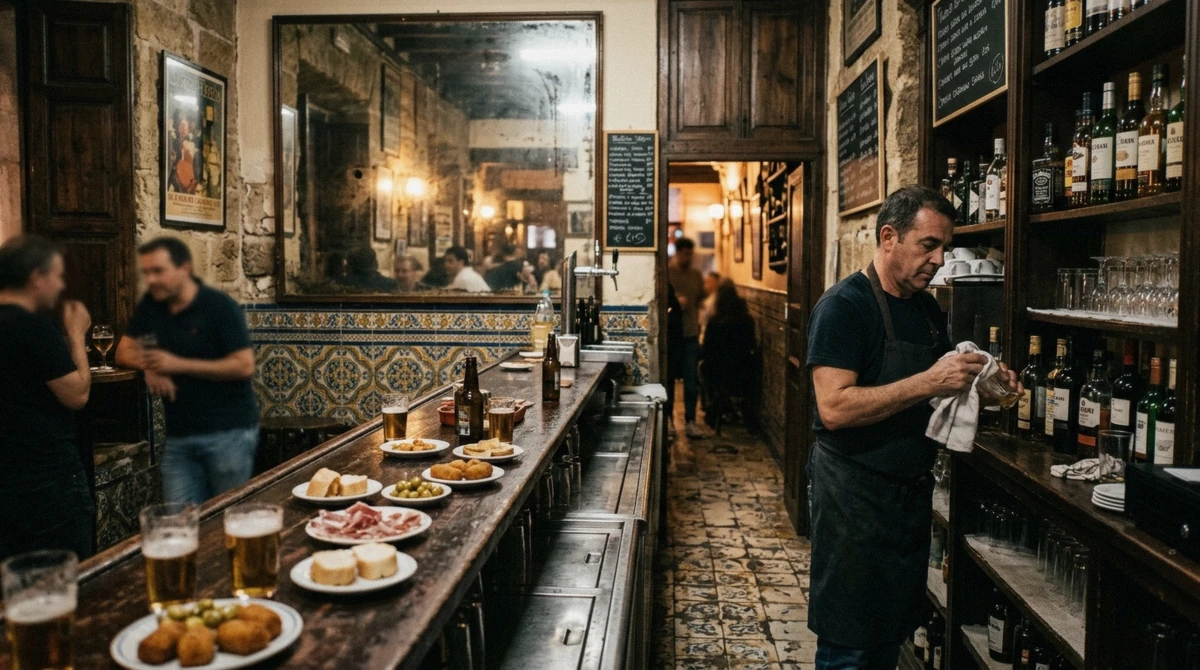
The oldest bar in Seville, founded in 1670 and in the hands of the De Rueda family since 1858. Hams hang above dark wooden counters, barrels stand in for tables downstairs, and the bill is still chalked on the wooden bar in front of you as you order.
Order the espinacas con garbanzos, around EUR 3.50 and the benchmark version of the dish, plus croquetas and a plate of gordal olives. It is busy, it knows it is famous, and it is still worth the twenty minutes of standing. Come at 13:00 or 20:00 rather than at peak.
Bodeguita Romero and Casa Morales
Bodeguita Romero, run by Pedro Romero's family since 1939, serves what many locals call the best montadito de pringa in the city: the shredded puchero meats in a warm roll, a few euros, and the reason to walk past the first three bars you see. Their carrillada iberica, pork cheeks braised to collapse, is the other order.
Casa Morales has been family-owned since 1850 and still looks like a wine warehouse, because that is what it was: enormous clay tinajas along the wall, no music, no decoration. Andalusian classics, and the tripe stew, callos, has its own day of the week.
How the district works
The blocks between Plaza de la Encarnacion, Plaza del Salvador and Calle Alfalfa are the densest good eating in the city, and the price gradient is brutal: two streets from the Cathedral the identical plate halves. Every guided evening in the catalogue starts somewhere in here: the Spain Food Sherpas walk at the white fountain on Encarnacion, the Secret Food Tour under an orange umbrella on Plaza del Salvador.
If you are eating alone, work north and east away from the monuments. The rule is simple: if the menu has photographs or a person outside inviting you in, keep walking.
Santa Cruz, Triana, Alameda
Santa Cruz: beautiful, and mostly a trap
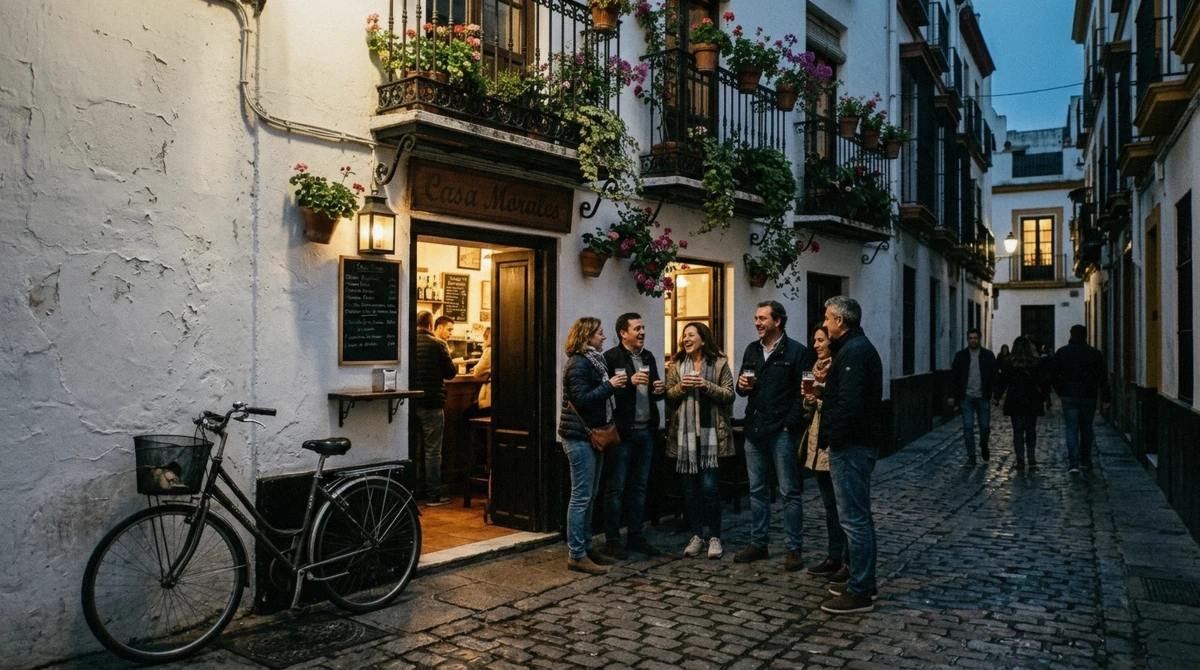
The old Jewish Quarter is the prettiest place to eat in Seville and the easiest place to eat badly. Whitewashed lanes, orange trees, and a high concentration of kitchens serving people who will never come back.
The exception worth queueing for is Las Teresas, open since 1870: a narrow room of dark wood, old bullfighting posters and hams over the bar. Order jamon, the grilled tuna morrillo, judiones with ham. The tapas and flamenco evening uses this quarter deliberately, taking Iberian ham and croquetas in one of the old bars before the show, which is one way to eat well here without doing the research yourself.
Triana: fish, sherry and the river
Cross the Isabel II bridge and the food changes. Triana was a barrio of potters, sailors and flamenco families, and it still eats more fish, drinks more sherry and cares less about how it looks doing it.
Start at Mercado de Triana, stalls trade Monday to Saturday 09:00 to 14:30, then eat along Calle San Jacinto and the streets behind it rather than on the river frontage itself. Calle Betis is for the view at dusk, not for the cooking. The Triana market tasting works the market stalls with a guide, and the Triana tapas tour does the barrio's bodegas in one evening.
Alameda and Feria: where the city eats now
North of the centre, the Alameda de Hercules went from red-light district to the city's nightlife spine, and the modern tapas kitchens followed. This is where you find reworked classics, more vegetables, and menus that a vegetarian can read without wincing: see the vegetarian and vegan guide.
Calle Feria, running north from it, holds the Thursday street market and the older shops. It is also the direction the morning market tour works, starting at the churros kiosk in Macarena further north still.
Rules That Save You From the Bad Meal
The five signals
Seville makes it easy to eat badly in the wrong three hundred metres. These are the signals that reliably sort one bar from the next.
| Signal | What it means |
|---|---|
| A person outside inviting you in | Turn around. Good bars in Seville are full without help |
| Photographs on the menu | Written for people who cannot read the menu, and priced accordingly |
| Locals standing at the counter at 21:30 | The strongest single indicator in the city |
| A short chalkboard that changes | The kitchen is cooking what the market had |
| Paella advertised on a board outside | Valencian dish, tourist trade: order it in Valencia |
Timing beats every recommendation
A great bar at 21:00 on a Saturday is a wall of shoulders; the same bar at 13:30 on a Tuesday is a conversation with the barman. If a place on your list is impossible, come back at lunch.
And remember the clock: kitchens close after lunch and most do not serve dinner before 20:00 or 21:00. Arriving at 19:00 hungry means drinks and cold counter tapas, which is exactly the window the evening food tours use to get a group through four bars before the city sits down.
The Bars, Side by Side
What each institution is known for
Four names come up in almost every serious list of the city's bars, and each is known for something specific rather than for being generally good. Founding dates are the bars' own.
| Bar | Since | District | What to order |
|---|---|---|---|
| El Rinconcillo | 1670 | Centro | Espinacas con garbanzos, croquetas, gordal olives |
| Casa Morales | 1850 | Centro | Andalusian classics from the barrel room; stew on its set day |
| Las Teresas | 1870 | Santa Cruz | Jamon, grilled tuna morrillo, judiones with ham |
| Bodeguita Romero | 1939 | Centro | Montadito de pringa, carrillada iberica |
How to use a list like this
Not as an itinerary. Four famous bars in one evening is a queue, not a tapeo, and the fourth will be the worst experience of the night because you will arrive at 22:30 with nowhere to stand.
The better use is as anchors. Pick one, arrive when it opens or at 13:30 for lunch, eat two plates standing, then walk two streets in any direction and pick a bar with no English menu and people at the counter. That second bar is where the evening usually gets good, and it is the one nobody can put on a list because it changes every year.
This is also the argument for taking a guided crawl on your first evening: the guide has already done the walking-two-streets part, several hundred times, and the route reflects it. Every listing on the Seville food tours page states which district it works and where it meets, so you can pick the barrio as well as the format.
Where to Eat Tonight
If You have one evening and want the classics
Centro and Alfalfa. Start at El Rinconcillo when it opens, then walk east into the Alfalfa streets.
If You are staying in Santa Cruz and do not want to walk far
Las Teresas, and after that head north out of the quarter. The lanes closest to the Cathedral are the most expensive eating in the city.
If You want the atmosphere more than the checklist
Cross to Triana in the early evening: the market end for tapas, Calle Betis for the view once you have eaten.
If You are vegetarian or vegan
Alameda de Hercules and Calle Feria. The vegetarian guide has the dishes and the phrasing.
If You would rather not plan it at all
Book an evening tapas tour for night one and use the guide's stops for the rest of the week.
The Etiquette That Gets You Served
How a Seville bar actually works
There is no queue and there is no host. You find a gap at the counter, catch the barman's eye, and order one thing. Waving, shouting and standing back politely all fail, in that order. The correct volume is conversational and the correct opening is simply the name of a dish.
You do not pay per round. The barman chalks or remembers what you have had and you settle at the end, which is why walking out without asking causes real confusion. Say la cuenta, por favor when you are ready to move on.
One plate at a time is the rhythm. Ordering four dishes at once turns a tapeo into a dinner, and the point of the format is that you leave after twenty minutes and do it again two streets away. Two tapas and a drink per bar, three or four bars, is a full evening at about EUR 20-25 a head, as set out in what a Seville tapeo costs.
Standing, sitting and groups
The counter is the cheapest place in the bar and usually the best one. Prices step up at a table and step up again on the terrace, and the difference is printed in small type at the foot of the menu. In the streets facing the Cathedral, a plate that is EUR 3 at a counter is about EUR 7 outside.
Groups are where this breaks. Four or more people cannot realistically eat standing in a busy bar, so a party of six ends up on a terrace paying tourist prices without ever deciding to. Split into pairs, or book something where the table is already held, which is one of the few concrete things a guided tapas crawl buys you.
Tipping is light: locals round up or leave a euro or two on a table of tapas, and nothing at the counter is normal rather than rude.
Questions About Tapas Bars in Seville
What is the best street in Seville for tapas?
Calle Alfalfa and the streets around Plaza del Salvador in Centro, and Calle San Jacinto and the lanes behind it in Triana. Avoid the terraces directly facing the Cathedral, where the same plate costs roughly twice as much.
What is the oldest tapas bar in Seville?
El Rinconcillo, founded in 1670 and owned by the De Rueda family since 1858. Order espinacas con garbanzos, croquetas and gordal olives, and expect to stand.
Do I need to book a tapas bar?
Generally no: the classic bars do not take bookings, which is why they fill. Go early, eat standing, or take a guided crawl, which gets a group of ten into four bars that would not seat you otherwise.
Where do locals eat in Seville?
Standing at the counter in Centro and Alfalfa, in the barrio bars of Triana away from the river frontage, and increasingly in the modern kitchens around the Alameda de Hercules. Rarely on a terrace facing a monument.
Is Triana worth crossing the river for?
Yes, for the market in the morning and the barrio bars in the evening. It eats more fish and drinks more sherry than the centre. The Triana tapas tour covers it in one evening if you would rather not plan it.
How many tapas should I order per person?
Two or three tapas plus a drink at each of three or four bars is a full evening: roughly EUR 20-25 a head. Order one plate at a time: the point of a tapeo is to keep moving.